By the time installation day gets here, the important decisions are already made. The new equipment should
have good a reason for being there, and “it’s the same tonnage as the old one” isn’t a good reason at all.
Before Phoenix Home Comfort recommends replacement equipment, we want to understand the house and what you’re hoping the new system will do better. The old one may simply be at the end of the road, or the replacement may be a chance to finally fix the things the old system never handled well. Sometimes it’s an upstairs that never quite catches up, or there’s one room everyone already expects to be uncomfortable. Other times, the house just feels damp all summer no matter where the thermostat is set.
A Manual J load calculation gives us
a much better answer than square footage alone because it accounts for the things that actually change how much heating and cooling the house needs. Windows, insulation, sun exposure, air leakage, duct location and the way the home is built all play a part. Two houses can have the same square footage and need different equipment once you actually look at them.
Go too large and the air conditioner may satisfy the thermostat before it has spent enough time running to pull much moisture out of the house. Go too small and you get the opposite problem, with the system running through the hottest part of the day and still struggling to catch up.
Once we know what the house actually needs, the equipment choices start making a lot more sense.
For many East Tennessee homes that means looking at heat pumps, while others may be better suited for dual fuel or an air conditioner paired with a gas furnace. A lot depends on the house, but also on what you want the new system to do differently from the old one.
Efficiency is part of that comparison.
SEER2 and HSPF2 give us useful numbers to work with, but they’re only one piece of it. A higher rating doesn’t automatically fix humidity or make a stubborn upstairs more comfortable.
That’s where things like staging and variable-speed operation can become worth paying for. Instead of running full blast every time the thermostat calls, the system can spend more time operating at lower output, which can make a noticeable difference when humidity and even temperatures matter to you. Of course, none of that helps much if the system was sized wrong or doesn’t have the airflow it needs.
We also spend some time on the stuff that probably isn’t going to sell anyone on a shiny new HVAC system today, but matters a whole lot more five or eight years from now. If a control board fails, can we get one? Is there good distributor support locally? What does the warranty actually cover, and how well does the manufacturer support the equipment after the sale?
Those differences are part of what you’ll see in
the multiple options Phoenix Home Comfort puts together. We’ll show you what changes as you move from one system to another, where the extra money is going, and whether those differences are actually useful for your home. You don’t have to pay for every feature just because it exists.
Installation day is only part of the installation
Most straightforward residential HVAC replacements are completed in a single day. Major ductwork changes, electrical work, zoning, multiple systems or other upgrades can stretch that out, but none of that will be a surprise when the crew shows up.
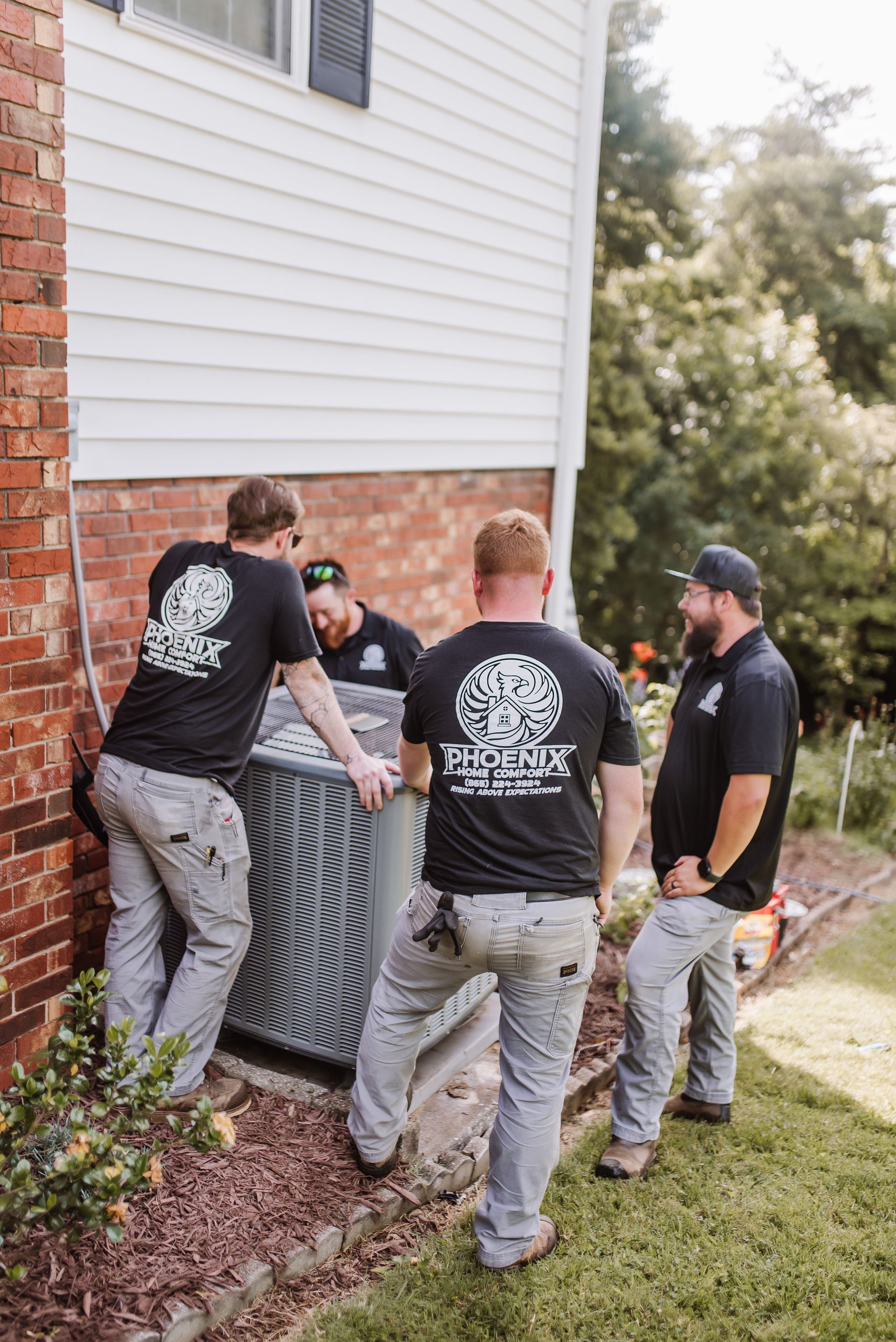
We’ll protect the areas we’re working in, remove the old equipment, set the new system and make the connections needed to get everything running.
Getting the shiny new equipment in place is the visible part. What matters next is how it runs.
Once it starts up, we need to see what it actually does. Airflow gets checked, refrigerant charge is verified, and we go through electrical operation, safety controls, thermostat setup and condensate drainage. If something needs adjusted, this is when we want to find it.
Around Loudon, we’re not exactly short on water.
Fort Loudoun, Tellico, the Tennessee River, the Little Tennessee... great for weekends, a little less charming when the July air feels like you can cut it with a knife. Your air conditioner is pulling moisture out of that indoor air every time it runs, and all of that water has to drain somewhere.
We want to see that condensate drain moving water the way it should, but startup goes well beyond the drain. Airflow, refrigerant charge, and the rest of the system still need to be right before we call the install finished.
Before we leave, we’ll walk through the thermostat and anything about the new system that works differently from what you had before. Ask questions. Change the temperature. Make us show you where that one setting is that you know you’re going to forget five minutes after we leave.
It’s your system. You should understand how to use it, and honestly, we like talking about this stuff more than most people probably do.
Phoenix Home Comfort also handles the manufacturer registration on the systems we install. Our standard installations include a 10-year manufacturer parts warranty and three years of labor coverage, with longer labor-warranty options available for homeowners who want them.
If you’re planning an HVAC installation in Loudon, TN, Phoenix Home Comfort can help you compare heat pumps, air conditioners, furnaces, and dual-fuel systems for your home. We install throughout Loudon and the surrounding East Tennessee area.
You can
review financing options,
request an appointment online, or call (865) 224-3924 when you’re ready to start comparing systems.